The most expensive mistake in this trade is not a ruined hood. It is a two-day course that hands you a certificate, a tote bag, and no usable skill, after which you spend the next eight months teaching yourself the things the course was supposed to teach you, on customer cars, at your own risk. I have watched that happen to people more times than I would like to count, and the pattern is almost always the same. They bought the credential instead of the training.
The demand is real, which is part of why the training market has filled up so quickly. Grand View Research put the global paint protection film market at USD 527.5 million in 2025 and forecasts USD 744.8 million by 2033, a compound annual growth rate of about 4.2 percent. That is steady rather than explosive, but it is enough to keep shops hiring and enough to make “PPF installer training” a product that a great many people now sell. Some of those programs are serious. Some are a weekend and a laminated card.
This guide walks the path in order, from no experience to your first paid installs, and explains what each stage actually costs you in time and money.
What a PPF Certification Actually Certifies
Before anything else, it helps to understand what the word certification means here, because it does not mean what it means in a licensed trade.
There is no government licence for paint protection film installation in Canada or the United States. Ontario, for instance, recognises 23 compulsory trades where you cannot legally work without a Certificate of Qualification, and the list covers work such as plumbing, electrical, and hairstyling. Automotive film application is not among them. You can legally wrap a customer’s car in film tomorrow with no credential at all.
So a PPF certification is not a licence. It is one of two other things.
Manufacturer certification is issued by a film brand. It confirms you have been trained on that brand’s product and, in most cases, registers you as an authorised or approved installer, which is what gives you access to the manufacturer’s warranty coverage for your customers and your access to their pattern software. It is a commercial relationship as much as a qualification.
Independent training is issued by an academy or a working studio. It confirms you attended and completed a course. It carries no warranty authorisation and no brand registration. What it is supposed to give you instead is transferable installation skill that works on any film you pick up afterwards, plus, in the better programs, some grounding in pricing and shop setup.
Both have a place. They are not substitutes for each other, and a good deal of the confusion in this market comes from programs that blur the line.
Step One: Decide Whether You Are Buying a Credential or a Skill
This is the first real fork in the road, and getting it wrong is what produces the certificate-with-no-skill outcome described at the top.
Manufacturer programs are generally built for people who already install. XPEL, for example, states plainly that its training classes are exclusively for current authorised installers, which means the door is closed to a complete beginner until a dealer account exists. 3M runs its paint protection film installer training through EPD University as a three-day hands-on class covering pre-cut kit fitting, bulk film work and squeegee technique, with a certificate of completion at the end and the 3M Paint Protection Film Preferred Installer title granted separately after you pass an installation test within twelve months. SunTek, Avery Dennison, and STEK each run their own installer programs on broadly similar lines, typically a small number of days, typically tied to their dealer network.
Read those formats carefully, because they tell you the assumption underneath. A three-day manufacturer class is not designed to turn a person with no film experience into an installer. It is designed to bring an existing installer onto a specific product line and into a specific warranty structure. People with no background who buy into one of these classes are frequently the ones who leave frustrated.
Independent academies and working studios are where beginners usually start. Providers in this category in Canada include Tint Academy, Wrap ID and The LAB Canada, among others, and the offerings vary widely in length, class size and how much of the time is actually spent on a vehicle. There is no accrediting body sitting above them, which means quality is uneven and you have to do the diligence yourself.
The practical rule I give people is this. If you have never touched film, book independent training first and worry about manufacturer certification once you have a shop, a dealer account and a reason to want the warranty. If you already install and you want to sell a specific brand, go straight to that brand’s program.
Step Two: Get Into a Room With Film and a Car
Online PPF courses exist, and they are not worthless. Video is a reasonable way to learn the theory, the sequence of a job, the vocabulary and the failure modes, and it is a reasonable way to review something you half-remember at eleven at night before a job.
But film installation is a manual skill with a feel component that does not transmit through a screen. Slip solution ratios, how much heat a panel will take before it fights you, when the film has relaxed enough to tuck, the difference between a stretch that will hold and a stretch that will lift in three weeks: none of that is learned by watching. It is learned by ruining material.
So the sequencing that works is theory online if you like, then in-person hands-on time as the actual training. Treat any program that is online only as supplementary. When you evaluate an in-person course, the question that matters most is not how many days it runs. It is how many hours your hands are on a car, and whether that car is a real vehicle or a set of loose panels on a stand.
Loose panels are fine for teaching a technique in isolation. They are not fine as the whole course, because the hard part of this work is the geometry of a real vehicle: bumper corners, mirror caps, the recess where a hood meets a fender, the door edge that will not tuck. A program that never puts you on a full vehicle has trained you for the easy half of the job.
Step Three: What a Real Course Actually Contains
Here is where the difference between a serious program and a weekend certificate becomes visible. A course worth paying for covers the whole job, in the order the job happens, rather than only the visible part where the film goes on.
Vehicle intake and inspection. Documenting existing paint defects, rock chips, previous bodywork, and panel gaps before you touch anything, so that a pre-existing problem does not become your problem.
Surface preparation. Wash, decontamination, clay bar, edge cleaning and drying. A large share of installation failures trace back to a surface that was not properly prepared, and this is the stage beginners rush.
Material preparation. This splits into two skills that a good course teaches separately. Pre-cut kits are generated from pattern software, most commonly DAP in the case of XPEL-aligned shops, and the skill there is plotter operation and pattern modification. Bulk film is cut by hand on the vehicle, and the skill there is knife control, relief cuts, and knowing where a seam can hide.
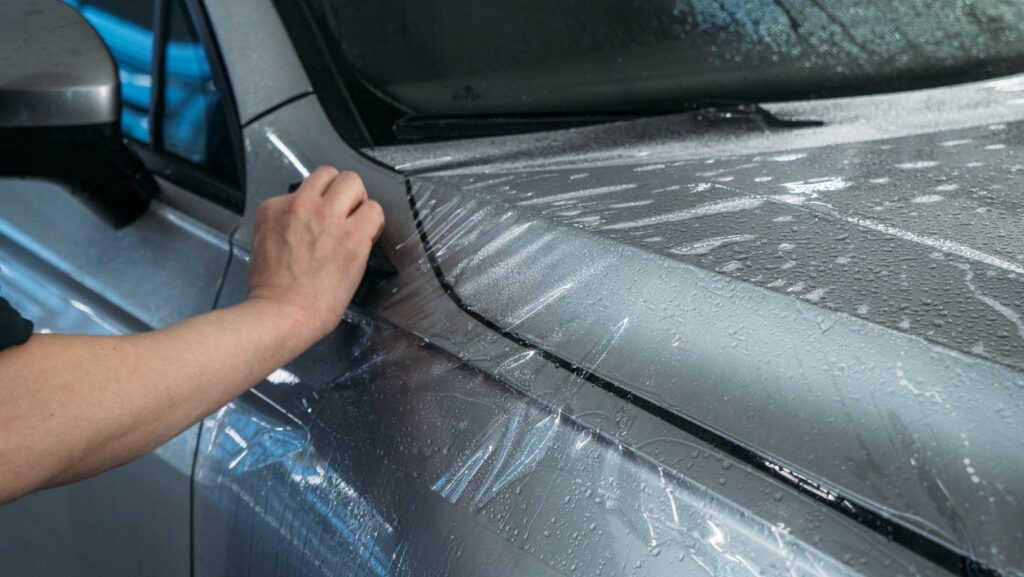
Application and trimming. Slip and tack solution mixing, squeegee sequence, heat gun use, stretching, tucking, wrapped edges versus cut edges, and how to handle the panels that give everyone trouble: bumpers, mirrors, hoods, fenders, doors, and trunk lids.
Curing and handover. How long the film needs, what the customer must not do in the first week, and how to explain that without sounding like you are covering yourself.
Correction. What to do when a piece lifts, when contamination gets trapped, when a stretch mark appears. Every installer produces these. Only trained installers fix them cheaply.
The other thing that separates a real program from a certificate mill is what happens after the last day. Skill built in a compressed course decays quickly if you do not immediately apply it, and most graduates do not have a car waiting. Some studios build in return practice time and a support window for exactly this reason. A Concord, Ontario studio that has been in the market for over twelve years, https://id-protection.ca/, structures its paint protection film training that way: a six-day, forty-hour personal course capped at two students, who each complete two full-body installs, or a two-day group course capped at eight, covering a full front end, with a tool kit included, two additional days back in the studio one month after the course, and three to six months of follow-up support depending on the format. The PPF installer training course is delivered in the same commercial bay the shop uses for customer vehicles, with an instructor the studio lists as having over ten years of experience across North America and Europe.
Whether or not that specific format suits you, use it as a checklist. Ask any program how many students share the instructor, how many full vehicles you personally complete, whether tools and film are included, and what happens if you get stuck a month later.
Step Four: Budget for the Course and the Months After It
Course pricing varies more than almost anything else in this market, so treat the following as informed ranges rather than fixed figures, and confirm current pricing directly with any provider.
Group courses, typically two to three days with several students sharing an instructor, generally sit at the lower end, roughly the high hundreds to low thousands of dollars. Manufacturer classes commonly land in the middle of the range; 3M’s published price for its three-day class through EPD University, for example, is USD 2,995 per person, including installation tools. One-to-one or two-student intensive courses running five to seven days sit at the top, often several thousand dollars, and the premium buys instructor attention and vehicle time rather than more content.
Duration follows the same logic. Two days is an introduction. Five to ten days is the band where most serious beginner programs sit. Anything advertised as a full career qualification in a single day is selling a certificate.
What people underestimate is the cost after the course. A working starter toolkit, if it is not included, runs a few hundred dollars. Practice film is the bigger line item, because you will destroy material learning, and that is the correct use of it. If you intend to go independent rather than take a job, add a plotter and pattern software subscription, which is a recurring monthly cost, plus a clean indoor bay with controlled lighting and no dust. The training is often the smallest number on that list.
Step Five: Turn the Certificate Into Paid Work
Two paths open up after training, and they have different economics.
Working for a shop is the lower-risk route and the faster one for skill development, because you install every day. Pay is usually a mix of hourly and production bonuses. For a general benchmark on the surrounding trade, the U.S. Bureau of Labor Statistics reported a median annual wage of USD 54,890 for automotive body and related repairers in May 2025, and noted that new workers in that field generally need two to three years of hands-on experience before working independently. PPF is not the same occupation, and specialist film installers in busy metropolitan shops can earn above that figure, but the two-to-three-year timeline to genuine independence is the part I would take seriously. It matches what I have seen.
Running your own shop has a higher ceiling and a much wider spread of outcomes. A full-body install is a multi-thousand-dollar job, which looks appealing until you account for material cost, the hours a full body actually takes a newer installer, rent, insurance, and the redo you eat when something lifts. Be sceptical of any training provider that leads with income projections. If the marketing talks about earnings before it talks about hours on a vehicle, that is a signal about what the program is optimised for.
Manufacturer authorisation matters most on this second path, because warranty-backed film is easier to sell and because dealership and fleet work often requires it. That is the point at which paying for a brand certification stops being optional.
Common Questions About PPF Installer Training
Do you legally need certification to install PPF professionally?
No. Paint protection film installation is not a regulated or compulsory trade in Canada or the United States, so no government-issued licence is required. Certification functions as credibility with customers and, in the case of manufacturer programs, as authorisation to offer that brand’s warranty.
How long does it take to become genuinely competent after the course?
The course is the short part. Most people can complete a beginner program in two to ten days. Reaching the point where you can take on a full body install unsupervised, at a standard a paying customer should accept, typically takes several months of near-daily work after the course, and full independence commonly takes a year or more.
Is manufacturer training or independent training better for a beginner?
For someone with no experience, independent training is usually the better starting point, because most manufacturer programs assume you already install and some restrict enrolment to existing authorised dealers. Manufacturer certification becomes worth its cost once you have a business that needs warranty authorisation.
Can you learn PPF installation online?
You can learn the theory, the terminology and the job sequence online, and that is genuinely useful preparation. You cannot learn the manual technique that way. Every credible path includes in-person hands-on hours on real vehicles.
Where is PPF training available in Canada?
Training runs across the country, with the heaviest concentration in and around the Greater Toronto Area, plus programs in Vancouver, Calgary and Montreal. Manufacturer classes are frequently held in the United States, so factor travel and accommodation into the comparison if you are considering one.
The Short Version
- Certification in this trade is not a licence. It is either a manufacturer’s warranty authorisation or an academy’s record of attendance.
- Beginners generally belong in independent hands-on training first; manufacturer programs mostly assume existing installers and, in some cases, an existing dealer account.
- Judge a course by hours on a full vehicle and students per instructor, not by the number of days on the brochure.
- A serious curriculum covers intake, prep, pattern software and bulk cutting, application, curing and correction, in that order.
- Budget for tools, practice film, and, if you are going independent, a plotter and software, on top of tuition.
- Expect months of daily installs after the course before the certificate means anything commercially.
The uncomfortable truth about this trade is that the training market and the skill market run on different clocks. A course can be completed in a week. Competence cannot. The programs worth your money are the ones that admit this openly, keep the class small enough that someone watches your hands, and leave a door open for the month after the course when you get stuck on a bumper corner at nine in the evening and need to ask someone who has done it a thousand times.